A good yard does not start with buying plants or outdoor furniture. It starts with understanding the space.
DecadGarden yard tips by DecoratorAdvice focus on planning the space before decorating it. Start by studying sunlight, soil, drainage, movement, and how you use the yard. Then create functional zones, choose plants suited to local conditions, add practical lighting and seating, and build a maintenance routine you can realistically manage.
The most useful DecadGarden yard tips by DecoratorAdvice follow a simple principle: decide how the yard should work before deciding how it should look. Study sunlight, drainage, soil, movement, privacy, and the activities you want to support. Then build the design around those conditions.
This approach helps prevent common mistakes such as choosing plants that cannot handle the available light, placing furniture where people need to walk, or creating a yard that looks attractive but requires more maintenance than you can manage.
What Are DecadGarden Yard Tips by DecoratorAdvice?
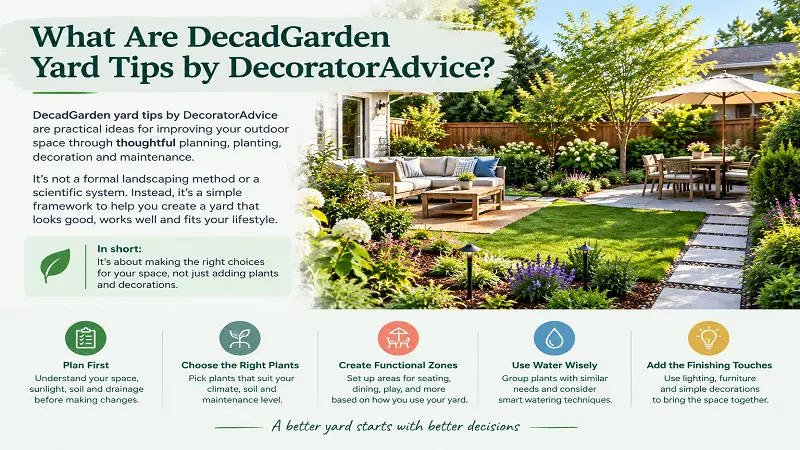
The phrase refers to practical ideas for improving a yard through thoughtful planning, planting, decoration, and maintenance.
It is not a formal landscaping method or a scientific gardening system. Instead, it can be treated as a useful framework for thinking about an outdoor space as a complete environment.
That means looking beyond individual plants.
A successful yard needs a sensible layout, appropriate plants, comfortable areas, suitable surfaces, and a maintenance plan that fits the homeowner.
Start by Understanding Your Yard
Before changing anything, spend time observing the space.
Look at the yard at different times of the day. Notice where sunlight reaches the ground, where shade remains, and where water collects after rain.
Also pay attention to existing features. A mature tree, fence, wall, slope, drainage point, or established planting bed can influence the entire design.
Check Sunlight Before Choosing Plants
Plant selection should follow site conditions rather than the other way around.
Penn State Extension recommends considering factors such as hours of sunlight, wind exposure, soil texture, drainage, temperature, and soil pH when choosing landscape plants.
This is important because a plant that performs well in one part of a property may struggle only a few metres away if the light or soil conditions are different.
Create simple categories such as:
- Full sun
- Partial shade
- Heavy shade
- Areas affected by reflected heat
- Areas exposed to strong wind
You can then match plants to each location instead of forcing the same planting style throughout the yard.
Examine Soil and Drainage
Do not assume that all parts of your yard have the same soil.
Some areas may drain quickly while others remain wet after rain. Soil may also vary in texture and pH.
If plants repeatedly fail in one area, replacing them with more plants may not solve the problem. The underlying soil, drainage, light, or plant selection may need attention first.
A soil test can provide useful information about pH and nutrient conditions before major planting decisions are made.
Create Zones Before Adding Decorations
One of the most useful DecadGarden yard tips by DecoratorAdvice is to divide the yard according to how it will actually be used.
Instead of treating the entire yard as one large space, identify separate functions.
Possible zones include:
- Seating and relaxation
- Outdoor dining
- Children’s play
- Lawn or open space
- Planting beds
- Vegetable or herb growing
- Storage
- Walkways and access routes
A small yard may need only two or three zones. A larger property can support more.
The goal is not to create as many sections as possible. The goal is to make movement and use feel natural.
Think About Movement
Walk the routes people will actually use.
For example, the route from the back door to an outdoor dining area should not force people through the middle of a seating arrangement.
Likewise, garden beds should not block access to storage areas or essential outdoor equipment.
A simple sketch can reveal these problems before you spend money.
Choose Plants for the Site, Not Just the Look
Beautiful plant combinations can be tempting, but appearance should not be the only consideration.
The right plant depends on factors such as:
- Local climate
- Sunlight
- Soil conditions
- Drainage
- Mature size
- Water requirements
- Maintenance needs
- Potential invasiveness
The U.S. Environmental Protection Agency recommends regionally appropriate, low-water-use plants where suitable. Native plants can also be valuable because they are adapted to local conditions.
However, “native” does not automatically mean “best” for every location. The plant still needs to match the specific conditions of the planting area.
Think About Mature Size
One common mistake is choosing plants according to their current size.
A young shrub may look perfect beside a walkway, but its mature width could eventually make the path difficult to use.
Check the expected mature height and spread before planting.
This small step can prevent years of unnecessary pruning or relocation.
Use Layers Carefully
A balanced planting area can combine different heights and textures.
For example:
- Lower ground-cover plants near the edge
- Medium-height perennials or shrubs in the middle
- Taller shrubs or small trees toward the back
The exact plants should depend on your climate and site.
The principle is more important than copying a specific plant list from another yard.
Make Water Use Part of the Design
Watering should not be treated as an afterthought.
EPA WaterSense guidance recommends considering soil, plant selection, and maintenance together when developing water-efficient landscapes.
Grouping plants with similar water requirements can make irrigation easier.
This is sometimes called hydrozoning.
Instead of watering every part of the yard equally, place plants with similar needs together where practical.
Mulch can also help reduce moisture loss and suppress weeds, although the correct mulch type and application depend on the plants and local conditions.
Avoid a Universal Watering Schedule
There is no single watering schedule that works for every yard.
Weather, soil, plant type, season, container size, and exposure all affect watering needs.
Check the actual condition of the soil and plants rather than following an arbitrary schedule.
Overwatering can be just as problematic as underwatering.
Keep Hardscaping Simple
Paths, patios, edging, retaining structures, and other hardscape elements provide the framework of a yard.
They should support the way you use the space.
A pathway leading nowhere useful adds visual complexity without solving a practical problem.
Similarly, a large patio can consume valuable space if you rarely entertain.
Before installing hardscape, ask:
- What problem does this feature solve?
- How often will I use it?
- How will water drain around it?
- How difficult will it be to maintain?
- Does it connect logically with the rest of the yard?
These questions can prevent expensive changes that look good initially but do not improve everyday use.
Add Outdoor Furniture According to Scale
Furniture should fit the zone rather than simply filling available space.
Measure the area before buying.
Leave enough room for people to sit comfortably, pull out chairs, and move around the furniture.
In a small yard, one well-sized seating arrangement may work better than several separate pieces.
For a larger yard, different seating areas can create distinct experiences without making the entire property feel crowded.
Choose materials according to your climate and willingness to maintain them.
A material that looks attractive but requires more care than you can provide may not be the best long-term choice.
Use Lighting for Safety and Function
Outdoor lighting should do more than make photographs look attractive.
Start with practical needs.
Consider lighting for:
- Steps
- Pathways
- Entrances
- Seating areas
- Outdoor cooking areas
- Changes in elevation
Then add softer accent lighting if it supports the overall design.
Avoid placing every light at the same height. Combining lower pathway lighting with carefully positioned accent or overhead lighting can create more visual depth.
Solar lights can be useful in appropriate locations, but their performance depends on available sunlight and the specific product.
For permanent lighting systems, follow local electrical requirements and use properly rated outdoor equipment.
Design for Maintenance From the Beginning
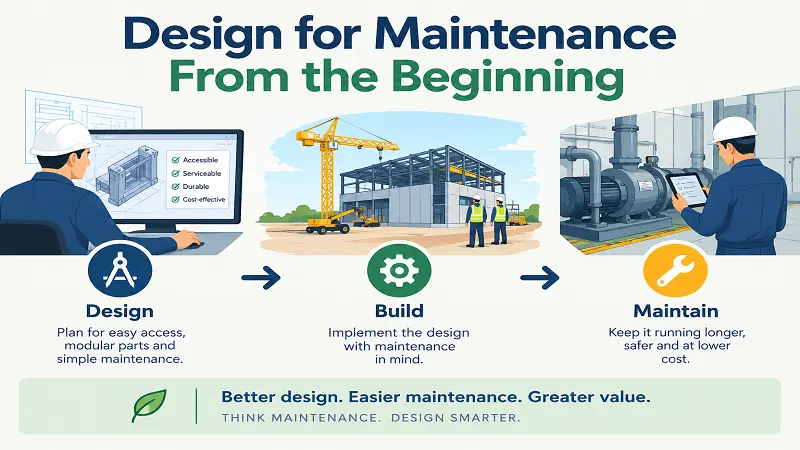
A yard is not finished when the plants go into the ground.
It needs ongoing care.
The best design is one that matches the amount of maintenance you are realistically willing to perform.
If you have limited time, avoid creating a landscape that depends on frequent trimming, complicated planting combinations, or large areas of high-maintenance lawn.
Instead, consider:
- Appropriate plant selection
- Simple planting layouts
- Mulched beds
- Practical pathways
- Efficient watering
- Easy-to-reach maintenance areas
- Sensible storage for tools
A low-maintenance yard still requires maintenance. The goal is to reduce unnecessary work, not promise a completely maintenance-free landscape.
Make Small Yards Feel More Useful
Small outdoor spaces require careful planning because every feature competes for limited room.
Use vertical space where appropriate.
Walls, fences, trellises, hanging containers, and carefully selected climbers can add greenery without using much ground area.
Keep the number of major materials and decorative elements limited.
Too many different colors, surfaces, furniture styles, and ornaments can make a compact yard feel even smaller.
Instead, repeat a few materials or visual elements to create continuity.
Improve Privacy Without Closing Everything In
Privacy does not always require a tall solid barrier.
Depending on the property, planting, trellises, screens, fences, or carefully positioned trees can help define a private area.
Think about where privacy is actually needed.
You may not need to screen the entire property. A seating area might need privacy while an open section of lawn does not.
Selective screening can preserve openness while making the most-used part of the yard more comfortable.
Build the Yard in the Right Order
A practical sequence can save time and money.
Observe
Study sunlight, drainage, soil, wind, existing vegetation, and movement.
Decide How the Yard Will Be Used
List the activities that matter most.
Do not design around activities you rarely perform.
Create a Basic Layout
Mark seating, pathways, planting areas, open space, storage, and other important zones.
Solve Structural Problems
Deal with drainage, damaged surfaces, unsafe steps, broken fencing, or other fundamental issues before decorative improvements.
Choose Plants
Match plants to the conditions and their mature size.
Install Hardscape and Major Features
Complete patios, paths, edging, structures, and other large elements before filling the space with smaller decorations.
Add Furniture and Lighting
Place practical elements according to the finished layout.
Add Decorative Details
Only after the main structure works should you add pots, ornaments, textiles, or other accessories.
Review Maintenance
After the first season, identify what requires too much work and adjust the design.
A Simple Budget Priority
If your budget is limited, do not spend everything on decoration first.
A sensible priority is:
| Priority | Focus |
|---|---|
| 1 | Drainage, safety, and structural problems |
| 2 | Functional layout and access |
| 3 | Soil and appropriate plants |
| 4 | Essential seating or outdoor-use features |
| 5 | Lighting |
| 6 | Decorative accessories |
This order is not a universal rule, but it helps distinguish improvements that solve problems from improvements that simply add visual detail.
Common Yard Mistakes to Avoid
Buying Plants Before Checking the Site
A beautiful plant is still the wrong plant if the location cannot support it.
Filling Every Empty Area
Open space is useful. It provides room for movement and prevents the yard from feeling overcrowded.
Choosing Plants Only for Their Flowers
Flowers are attractive, but foliage, structure, mature size, and seasonal interest also matter.
Ignoring Drainage
Repeatedly wet areas can create plant-health and usability problems.
Overdecorating
A few well-chosen features usually create a clearer design than a collection of unrelated ornaments.
Designing for Someone Else
A yard should support the people who actually use it.
A large dining area makes little sense if you rarely eat outdoors. Likewise, an oversized lawn may not be useful if you prefer gardening and seating.
A Practical Weekend Yard Audit
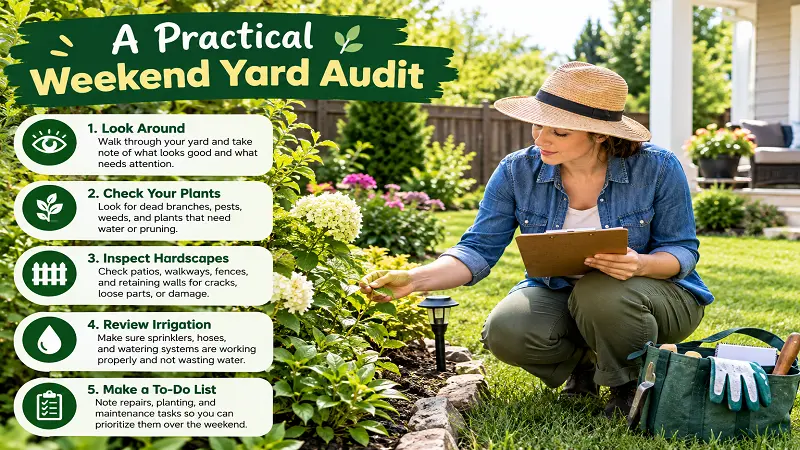
If you do not know where to begin, spend one weekend assessing the yard rather than buying anything.
On the first day, observe sunlight, drainage, movement, existing plants, and problem areas.
On the second day, make a simple sketch.
Mark:
- Seating
- Dining
- Paths
- Planting areas
- Open areas
- Storage
- Privacy needs
- Areas requiring repair
Then choose one high-priority improvement.
Starting with one clearly defined problem makes the project easier to manage and gives you a better chance of learning what works before changing the entire yard.
Final Takeaway
The most useful DecadGarden yard tips by DecoratorAdvice are not about copying a particular garden style. They are about making decisions in the right order.
Understand the site first. Plan how people will use it. Match plants to real conditions. Keep movement clear. Use water wisely. Add furniture and lighting for practical reasons, then finish the space with decoration.
A successful yard does not have to be expensive or complicated. It needs to work for the property and the people who use it.
Start with the problems that matter most, make one improvement at a time, and let the design develop from there.
7. FAQ section
What is the main idea behind DecadGarden yard tips by DecoratorAdvice?
The main idea is to plan an outdoor space around how it will be used. Sunlight, soil, drainage, movement, plant selection, seating, lighting, and maintenance should be considered before adding decorative details.
How should I start improving my yard?
Start by observing the yard at different times of day. Check sunlight, drainage, soil, existing plants, access routes, and the areas you use most. Then create a simple layout before purchasing materials or plants.
How do I choose plants for my yard?
Choose plants according to local climate, sunlight, soil, drainage, mature size, water requirements, and maintenance needs. Local extension services and reputable horticultural organizations can help with region-specific choices.
How can I make a yard easier to maintain?
Use plants suited to the site, group plants with similar water needs, keep the layout simple, avoid unnecessary lawn, use appropriate mulch, and make maintenance areas easy to access.
Should I decorate my yard before planting?
Usually, major structural decisions should come first. Establish the layout, pathways, drainage, hardscape, and main planting areas before adding smaller decorative features.